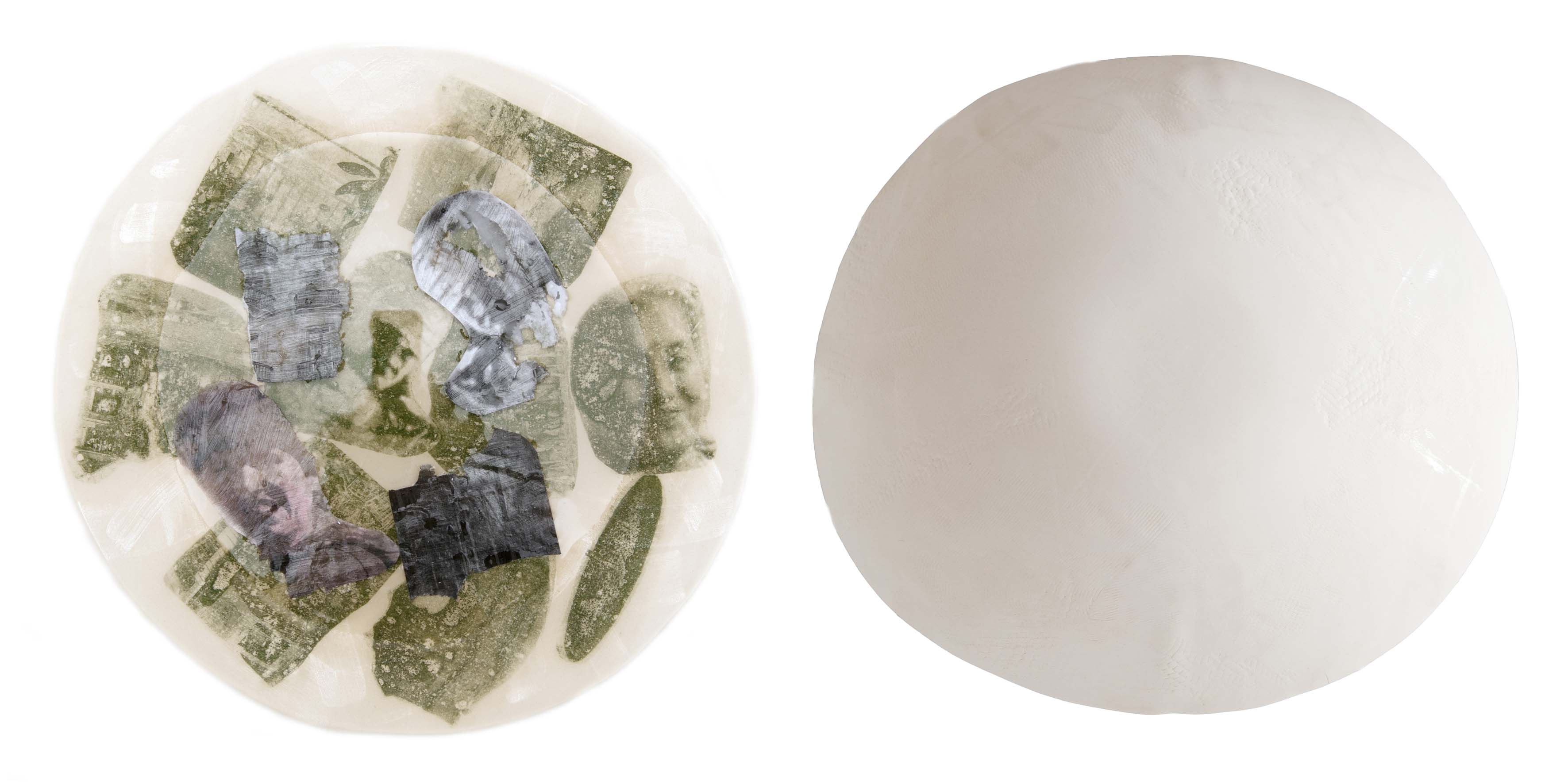
I meant to say, tongue, tong, tongues, tongs.
They looked at me, making sure I didn’t say it right and demanded repetition.
My tongue twists to form various shapes in an attempt to produce so-called correct pronunciation.
The tongue becomes heavy and broken.
I try to mend the broken tongue.
It only leaves the visible mark of the scar.
The pain of speaking a foreign language, not being able to speak my mother tongue, festers inside my mouth.
The pain of not being able to speak out the truth festers inside.
The tongue becomes mouldy, not being able to function.

My face of Asian recites bilingually over the white plaster face:
Close your eyes Listen to me You will understand.
I see. I understand. Do you have to see it to understand?
I mimic a white language, but my tongue cannot be white tongue like a porcelain. I cannot be the same as the white, aligning each other perfectly. The difference in language and culture cannot be erased to match harmoniously, but rather it is visible and should be.

Tongues that Smell, Taste, and Eat.
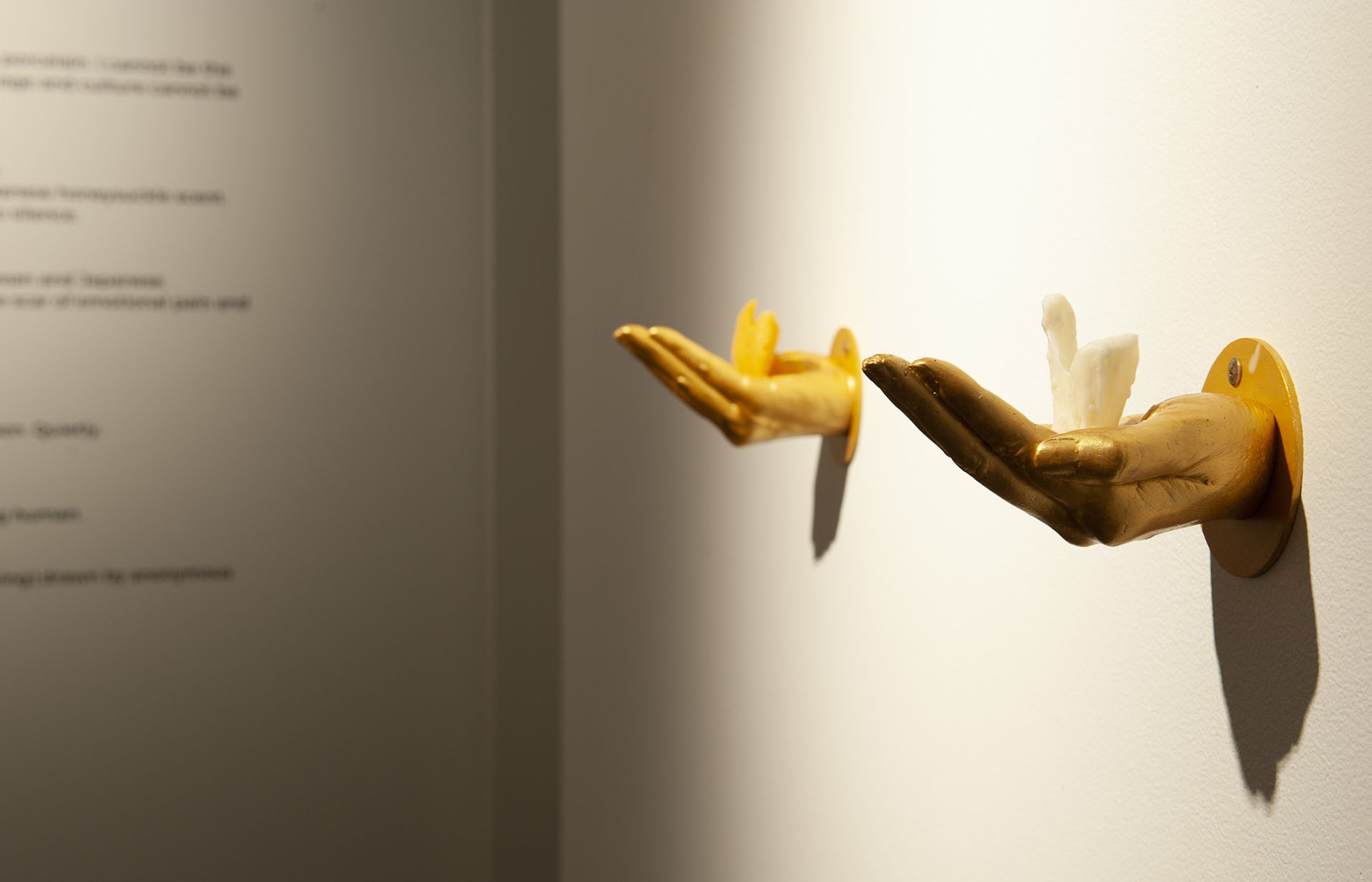
The difference in culture presents with the trace of scents from candles.
The aroma of essential Korean food, Kimchi, is overwhelmed by the Japanese honeysuckle scent. Japanese colonisation forced the mother tongue of Koreans to fade into silence.
Hold your tongue.
The authoritative voice demands silence.
When the Korean language was not allowed, it became bilingual in Korean and Japanese.
Mother tongue does not disappear but multiplies, marked by the visible scar of emotional pain and trauma in the process.
My tongue becomes bilingual in Korean and English in Australia.
I have both with differences. The scar remains.
White Porcelain requests the purity of women.
The only given role as a wife and a mother is serving a husband and a son, Quietly.
How dare, hold your tongue, men said.
The only given role as a colonised woman is a sex slave.
How shameful, hold your tongue, men said.
The youth is crushed like pressed flowers.
Red of oozing pain as a living human.
Try to mend with stitches, but the scar remains visible.
Marking the thick outer lines adapted from Minhwa (Korean folk drawing) drawn by anonymous female commoners during the hierarchal Confucian society of Korea,
I dedicate this work to Silenced Women.

Exhibition: 29 March to 6 May 2023, Manningham Art Gallery, the land of the Wurundjeri Woi-wurrung people of the Kulin nation.
]]>
The project, Mask, explores the notion of a mask through self-performed images to refute fixed identity and cultural perceptions based on a person’s ethnic background. It is a great opportunity to realise this project as the part of Mapping Melbourne 2020/2021 program, which shares the same value of advocating the equity of the human being with the perspective of an Asian-Australian.

The current Covid-19 pandemic offers the chance to reflect on how we live together and reminds us of the deeply rooted racial discrimination. The absurd syllogistic reasoning prejudges people based on their appearance. The project, Mask, refutes fixed identity based on ethnicity through multiple interpretations of a mask and performing body from a perspective of an Asian-Australian.
A mask serves as a vital barrier against the spread of viruses, protecting ourselves and others.
A mask defends against the physical and verbal violence toward individuals of Asian ethnicity who have been unfairly blamed for the virus.
A mask embraces the vulnerability of those facing discrimination and those with weakened immune systems.
A mask disguises selfish actions, serving as an excuse for survival amid uncertainty about the future.
A mask beautifies the appearance making fairer skin, reflecting the Eurocentric ideals of beauty and superiority.
A mask invites us to look beyond the surface, reminding us that true inner character lies within.
The unidentifiable blurring face and damaged Instant ID photographs imply the ambiguity of identity with the debate on the veracity of truth in the visual representation of appearances. Mask advocates the equity of the human being, colliding hierarchisation and binary structure of white and non-white people under the notion of humanism.

Online Launching Event: 10 December 2020, MAV (Multicultural Arts Victoria)
All works of Mask can be viewed at: https://www.mav.org.au/event/mask-by-soyoun-kim/
]]>Moving from one place to another is excitement with the curiosity of new life and an unexpected adventure. At the same time, it is an emotional challenge to depart from the familiarity of people and places known for years and find a new place to stand. This social and cultural dislocation brings a sense of absence in a new community.
In this exhibition, I try to convert this invisible absence into visible proof of existence through the visual language of self-portraits and landscapes. The space explores the traces and memories contained within. The self-performed image is drawn from my experience of diverse cultures and crossing borders as a Korean female immigrant. And these symbolic gestures in the photographs imply current issues such as racism, gender discrimination, social inequity and violence.
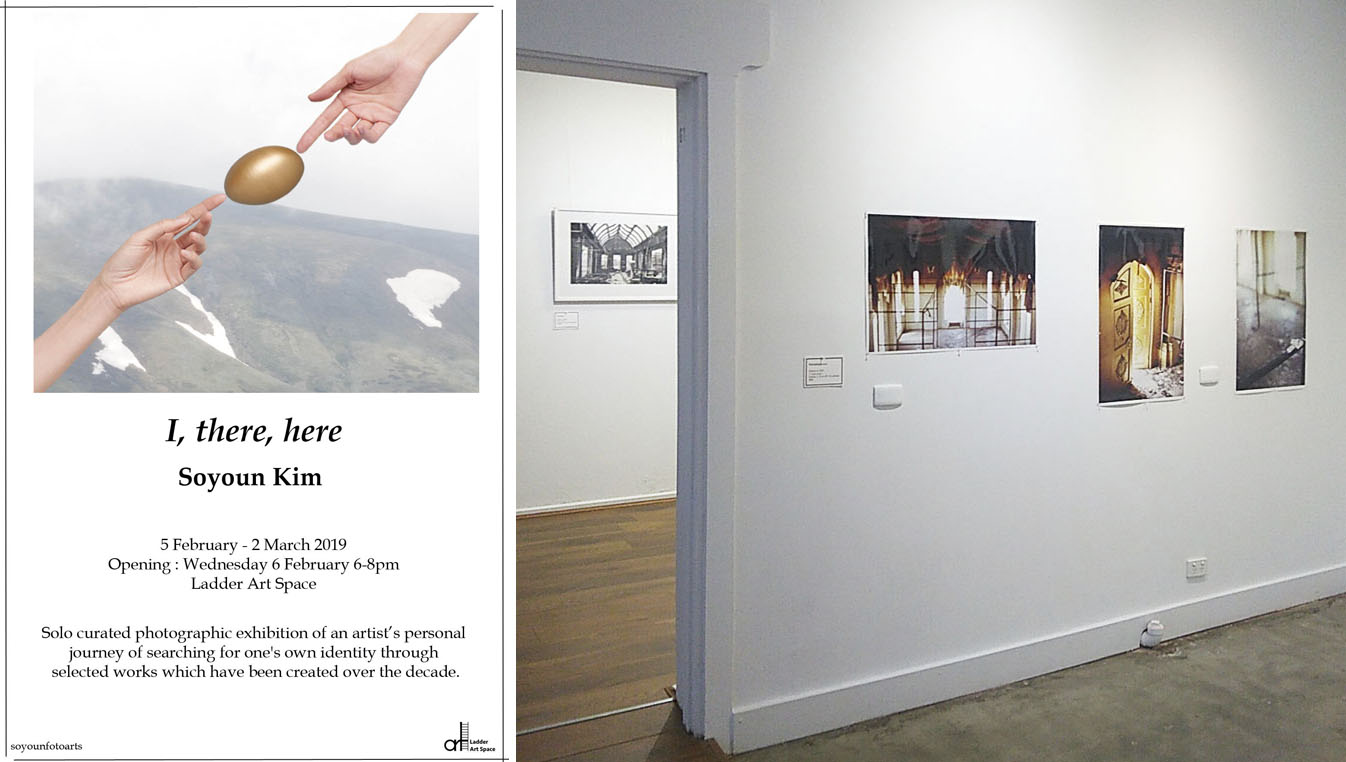
Serenity series is photographs taken in my hometown in Korea. This disaster of a fire from an unknown cause erases the marks and memories of the space but creates a serene atmosphere. The newly built building expects to start a new story within this place.
Dreamfield I depicts my first encounter with Australia as an expatriate, overlapping my body language and the Australian landscape. The blending and shifted colour with the crossing processing technique express emotional colour rather than the real colour of the landscape.
Easter Picnic, Hope is the artist’s journey for hope based on my experience of an injury. Referencing Edouard Manet’s painting The luncheon on the grass (Dejeuner sur l’Herbe 1862), I portray injured myself and another myself recovered a year later. These two wrapped faces symbolise the unforeseen and unexpected future. Easter represents the time of hope after overcoming obstacles and hardships in the artist’s journey.

Cadavre Exquis I is a montage interpretation of my identity based on personal preference. I depicted this ideal fantasy and dream in the way that I approached the drawing ‘Cadavre Exquis’. The title, meaning ‘exquisite corpse’, comes from a technique used by the Surrealists to create a collage of words or images, in which each participant is only capable of seeing the end of the previous word or image as contributed by the previous person, without knowing a whole picture. This technique reflects the process of creative collaboration under the same name, which I have employed in this project.
This montage image is applied as dissected physical body parts in confined boxes to examine a physical identity in Cabinet of Curiosities of Identity, as cuts and layers to rearrange the figure in Madonna, Munch, Self and as multiplied or divided several ‘I’ to express confused identities through dislocation in Self, with flowers.
3 Wise Monkeys examines perceived identities in the current society of vast information. Online platforms such as Facebook and Instagram influence the way of perceiving ideas and information through the instant reception of photographs and words. This tends to lead to an illusive reality with preconceptions, rumours and misunderstandings and even results in violence. I appeal to step forward with a clear vision of the mind like these 3 wise monkeys.

This silence of ‘no speak’ in 3 Wise Monkeys, is expressed further in I want to be in Peace not in Silence. Sheep have a general concept of being meek and mild animals in a peaceful manner, but they have horns to protect themselves and fight against any harm which might affect them. A society with acquiescent silence without speaking out truth and unfairness would create illusive and temporary peace and is expected to collapse eventually. Covering myself with sheepskin, I am shouting for true peace.
In the DUST series, dust symbolises the invisible harm factor, resulting in the victim of unfair treatment against human rights; We breathe the dust-polluted air of the development without concerning the natural environment and human condition; Victims of violence of terror are covered with dust from the destruction of buildings. I try to remove the dust and cover myself with plastic sheets for protection, but the thick layers of dust stay within me.
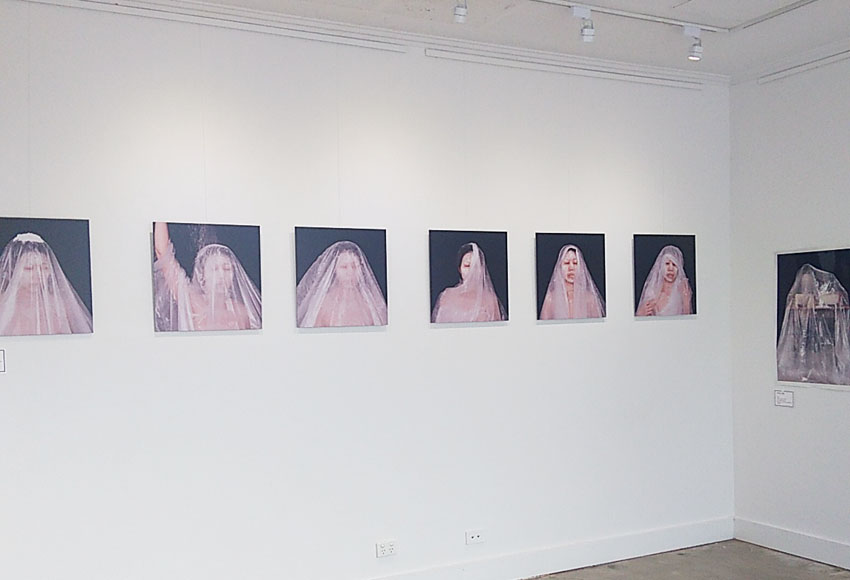
Birds represent a possible harm factor in Bird Net as bird net is used for protecting plants from birds. In this global society, the closed boundary under the name of protection for each nation can result in conflicts as a form of extreme nationalism and racism. These conflicts have been reiterated throughout the history of the world. It might suggest the conflict in human nature of belonging and intolerance of being different. Birds take fruits from trees and spread the seed to grow the next generation of trees, and it keeps flowing the life circle of nature. The open cultural exchange will generate more beneficial profits for each country and individuals to grow future development if we blur the boundary with a harmonious solution.

The most recent work, The Birth restates Michelangelo’s fresco painting, Creation of Adam, in which God breathes life into Adam as the first human being as a male. The Birth illustrates two identical female human figures who create an egg together as the symbol of the birth of life. The Korean myth of the founder of the Silla dynasty also tells the story of King Bak Hyeokgeose born from an egg.
——————————————–
Exhibition : 5 February – 2 March 2019 Ladder Art Space Melbourne Australia
]]>Through six photo-media installations, the exhibition tells the story of the relationship between a Korean war widow and an Australian mother who lost their loved family member during the Korean War; the story of the special connection between two families crossing cultural boundaries that have grown stronger from generation to generation; and the story of the friendship between two nations of Australia and South Korea during the time of hardship.
My Trip 여행 일지
Thelma Healy’s red travel diary opens the story as the first part of the installation in the same way the diary motivated the author to write her book, Passage to Pusan. The story unfolds chronologically like pages on the book, beginning with Thelma’s diary and ending with her granddaughter’s book. When this enlarged book format work is folded, the pages overlap as multi-layers, connecting the story crossing time and generations. Viewers who never have read the book would be introduced to the story through this work, comprising both archival images and recent photographs taken during the author’s visit to Korea in 2017.

Thank You 감사합니다
340 Australian soldiers died fighting for democracy in Korea during the Korean War from 1950 to 1953. Each soldier’s name is typed one by one with a wholehearted appreciation for their sacrifice. They are engraved gently on the traditional Korean paper, ‘Hanji’, which embraces the names with its warm texture. To mark the beautiful national relations, the Australian national flower, Golden wattle, is arrayed on the top left and the Korean national flower, Hibiscus Syriacus (무궁화), is on the top right.

Relations 인연
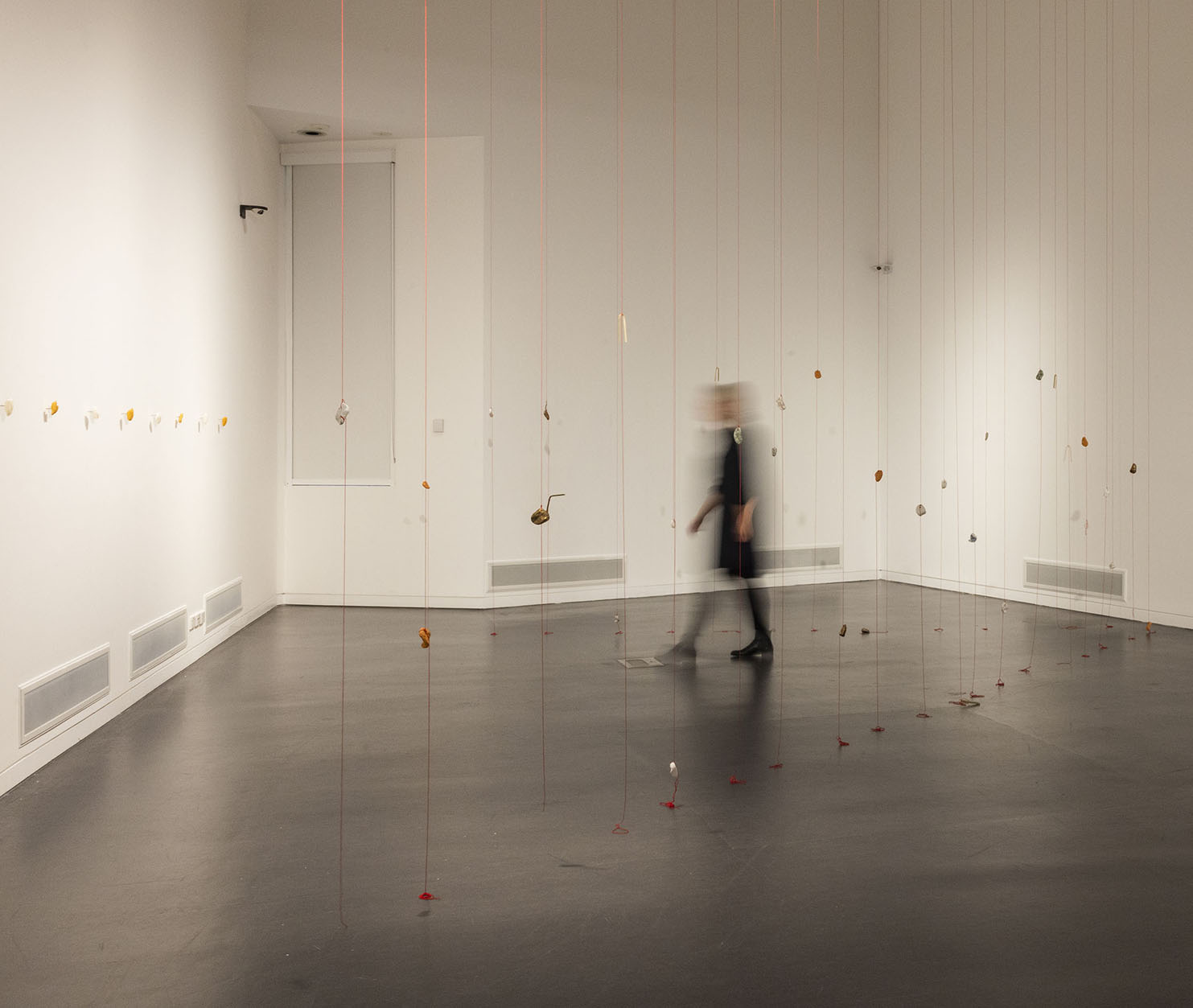
There are five ceramic boats in this exhibition : Vince Healy, Thelma Healy, Mrs. Kim Chang Keun, Sandgate & Pusan, and Korea.
Each boat tells the story of the journey of these people and their places. Born in Sandgate Australia, Vince died in Korean War and was buried in Pusan, where the Korean War widow, Mrs Kim Chang Keun, laid flowers on his grave on behalf of his mother, Thelma. The boat symbolises a journey: Thelma’s journey to Pusan began by boarding an ocean liner. Water is the ocean crossing between Australia and Korea. Water is tears shed by the sadness of losing family members and the happiness of gaining friendship. Water is the medium of connecting two layers of past images embedded in the ceramic and floating present-time images on the water. The water in the boat also connects present time, allowing the viewers to reflect on the water.
Relations 인연 has been created with the collaboration of the ceramic artist Somchai Charoen based on the project during the residency in ‘Belmore ITCH’.

Dear 친애하는
There are eight letters : two letters from Vince Healy to his mother Thelma, one from Vince to his siblings, one from Vince to his youngest sister Monica, two letters from Thelma Healy to her children, two letters from Mrs. Kim Chang Keun to Thelma Healy.
The original letters printed on transparent sheets are layered with the old family photographs printed on Hanji to evoke the emphatic sense of the words through the visual images. Reading these emotionally written conversations, love and caring are present. There is no explanation to add when reading every letter’s ending of Vince with the touching greeting to his baby sister, Monica: “P.S. How are you cheeky Monica?”

For Vince 빙스를 위해
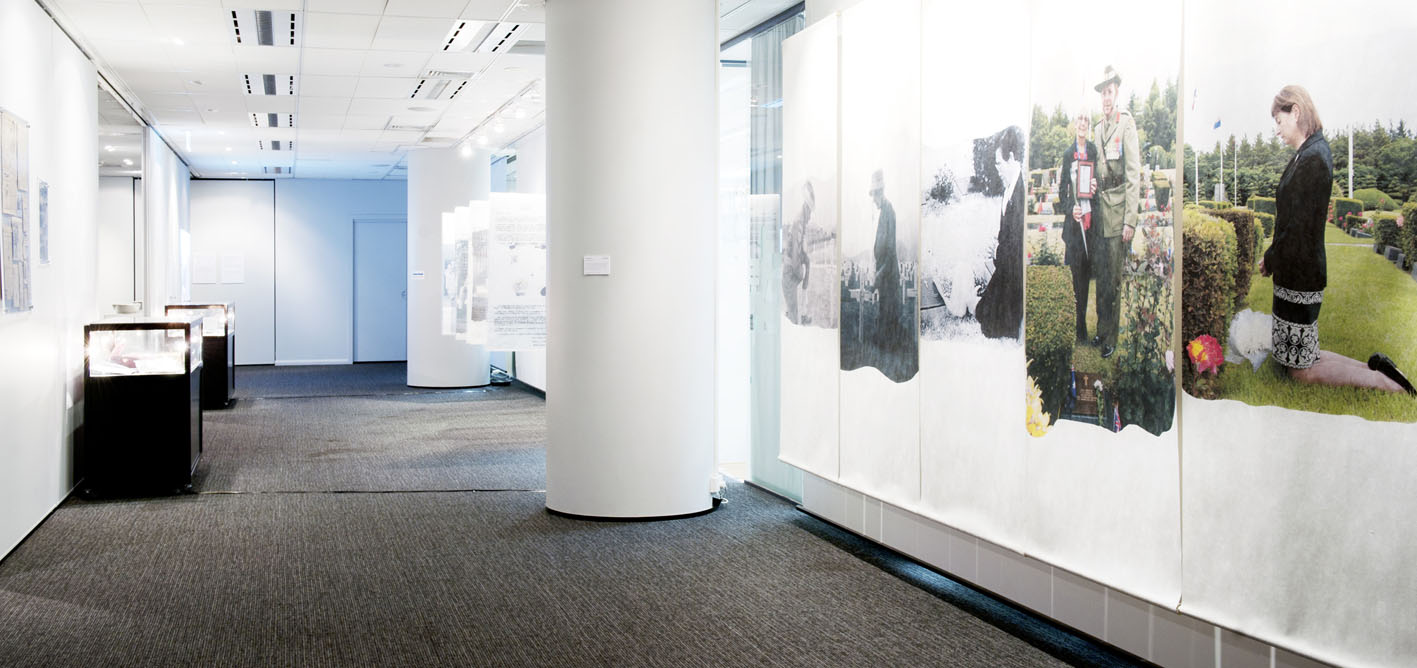
Vince Healy was killed in action at Maehwa Mt. South Korea during Operation Woodbine on 7 March 1951 at the age of 24. Since he was buried at the UN Memorial Cemetery in Pusan South Korea, there have been five significant visits to Vince’s grave.
Love & Peace 사랑과 평화
We lay a white chrysanthemum on each grave of an Australian soldier who died while fighting during the Korean War to wish them peace and to console their bereaved families. We appreciate their sacrifice for democracy and peace. The white chrysanthemum symbolises appreciation and sincerity, and Koreans use them as condolence garlands at funerals where they share the sorrow of losing loved and respected ones. Mrs Kim Chang Keun also laid white chrysanthemums on Vince’s grave with love and appreciation.
The Korean peninsula has been divided in two under the 38-parallel line and the armistice agreement since 1953. I hope there will be no more innocent victims under the name of war. I hope the world filled with peace and selfless love.


Exhibition : 23 June ~ 1 September 2017, Korean Cultural Centre Sydney Australia
]]>I had been looking through image files in my digital storage and photo negative/positive films and prints. The whole stack of images came out to the light, and I was reading this visual diary which has forgotten for a long time in my memory.
I took photographs of my family, friends, passer-by and myself at a specific moment and place to record as a visual memory. I took photographs of sceneries to record feelings that interacted with them. They are the proofs of ‘existence’ through time and space. In my vague memory relying on those vivid images in films and prints, I started to ask myself: Is this the one I ‘really’ saw? Those people and places seen in the past are now invisible in the present. Now, I even try to trace my feeling at that moment.
To visualise this concept, I created bowls (dishes), an eye and a camera lens, which could contain layers of images as the layers of memories. Through the residency, I also learnt the natural character of clay. The softness of the clay made it possible to imprint objects from my journeys and belongs to trace the memory. And it worked well with another natural medium, water, to connect the layers of images. Even though it was obvious that images on papers or gelatin sheets would be burnt in kilns during the process, I wanted to see the feeble evidence of existence like ashes. As a final process, I let paper images float on the water and connect myself to the present time by reflecting my face on the water.
From sorting photographic images to making clay bowls, it was my own meditation on tracing me.
From sorting photographic images to making clay bowls, this creative process was my meditation on tracing memories not long after receiving my cancer treatment.
This residency project, Seen Unseen, has been led to be part of the ongoing project, Passage to Pusan, which will be exhibited at Korean Cultural Centre Sydney in June.